By Sister Timothy Marie, O.C.D.
May I begin with a true story? It all happened in the year 1852. The Loretto Sisters ventured across the country into the wilds of New Mexico, a newly acquired territory of the United States. Among the sisters’ goals was the fulfillment of their dream of building an academy for girls in the territory. They wanted to call it Loretto Academy. The Academy took five years to build and by 1878, Loretto Chapel was added to the school. I visited this Chapel while working in New Mexico one summer. Today, the entire campus, including the Chapel, no longer belongs to the sisters. The Chapel has been preserved as a historical spiritual site.
Before long the dear sisters realized their mistake – a big one. Their new Loretto Chapel included a choir loft near the entrance door but . . . it was missing a staircase to reach it. So, in came a ladder, a precarious remedy, given its height.
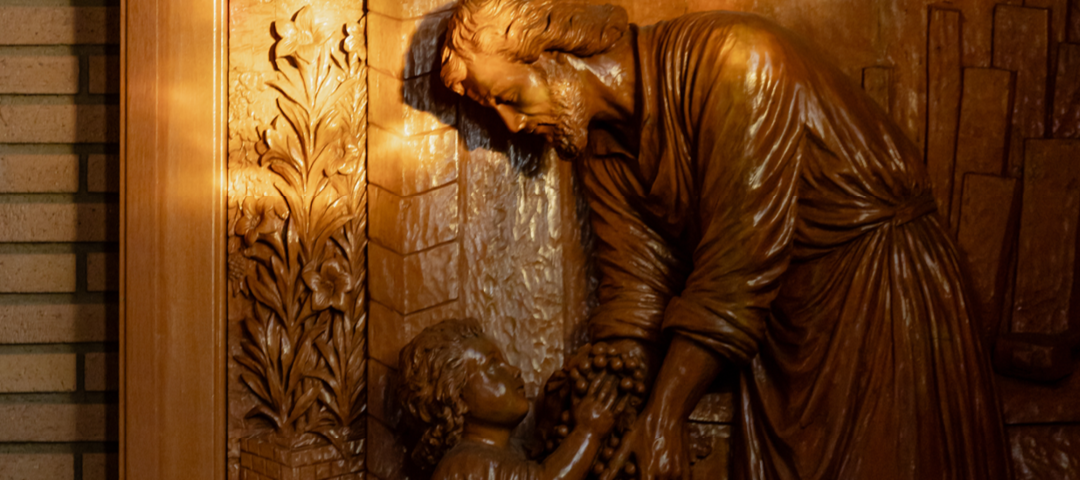
At the same time, however, the sisters decided to pray a novena to St. Joseph, the patron saint of carpenters, asking him to help them find a good carpenter to build a staircase. On the ninth day of their prayer (a novena is repeated for nine consecutive days), a man showed up at the Chapel. He brought his toolbox as he was looking for work. He was a carpenter. For many months, day after day, he worked on the staircase.
Months later, the mystery began, for the chapel now held an elegant circular staircase, a magnificent structure. To add to the mystery, the carpenter disappeared without pay or thanks. The sisters even ran an ad in the newspaper, trying to locate him to thank him. They concluded that he was St. Joseph himself who came in answer to their novena.
Why such a mystery?
As I remember from my visit, the staircase is circular, with two complete turns. The wood, a type of spruce, is not native to New Mexico. It has thirty-three steps, the number of years of Jesus’ lifetime. Its form is described as a helix, which is curved on a conical or cylindrical surface that would become a straight line if the surface were unrolled into a plane. There is no traditional central support beam for the staircase. The support consists of two layers of segments of wood fitted together to support the helix shape of the staircase.
There is a lot more information about its unique construction, which I don’t remember. What I do remember is that I consider my time spent in Loretto Chapel as a time of spiritual growth and a special blessing that I will never forget. And yes, it was Saint Joseph.
And what do you think?