
Every year, we celebrate St. Patrick’s Day on March 17, commemorating the life of one of Ireland’s most popular saints. Most people have heard of him and many choose to participate in one or more of the Irish traditions that are kept alive from year to year on St. Patrick’s Day. Of course, my parents, both of Irish descent, wove Irish expressions of Catholicism into our Irish-American-Catholic family life.
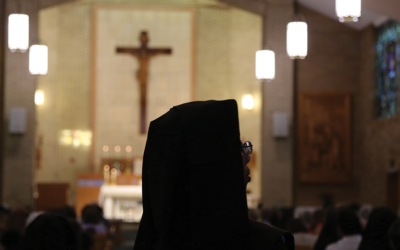
We blessed ourselves and said grace before meals faithfully. A crucifix was placed in almost every room of our home, including the wall above all beds. A statue of Our Lady had a prominent place in our living room. Rosaries were found in every bedroom. Children were duly baptized six weeks after birth and there were always religious-themed parties on the days of our First Communions and Confirmations. We all lined up for Confession together, as a family, every Lent. We sang Irish songs, played Irish ballads, and heard Irish stories. It was a blessed childhood. And when someone died, one month to the day, a Mass was offered for the repose of the soul of the deceased—the Irish practice called “month’s mind.”
Added to all this was the arrival of the Irish nuns, straight from the Emerald Isle, who arrived in Long Beach, California, our city, to teach the Faith “in America.” The Irish nuns taught me from third grade through eighth grade. In school, I listened to Irish music, and was taught in the traditional, classical method of the European 1950s. Example: I can recite Hiawatha and Paul Revere’s Ride among others, as well as answering the correct response to the questions of the Baltimore Catechism. With Irish “missionary” nuns as our teachers, girls were taught the proper curtsey reserved for the clergy and religious sisters and the boys the proper gentleman’s bow. We danced the Irish jig and were given Irish (and English!) history along with our American subjects. I know the dates of when William the Conquer conquered England, at the time of the Norman conquest, and subsequently crowned himself King in 1066 AD. I know that the Magna Carta was signed in 1215 AD.
Perhaps most of all, I remember St. Patrick. We prayed his prayers coupled with beautiful Celtic Catholic customs. Such respect for God! Such honor we gave Him! So many stories (legends?) we heard about Him! As I think back on it, I think I describe my upbringing as immersed in a subculture of our “Irish homeland” as we took up the banner of our legacy into the 20th and now the 21st centuries. And it is a blessed legacy. I wouldn’t change it. My mom once told me: “Your ancestors have suffered for the Faith.” A statement that, to this day, I have never forgotten.
So, on St. Patrick’s Day 2026, I’d like to pass something along to you about St. Patrick. He took something bad—he was an English lad who was kidnapped by pirates at the age of sixteen—and pirated away to Ireland where he lived in harsh conditions for six years. It is said that he had a spiritual vision through which he was guided to escape back to England. Instead of becoming angry and bitter because of this abduction, he resolved to bring Catholic Christianity back to Ireland. First, he became a priest and subsequently a bishop. He returned as a bishop. Known today as the great missionary of Ireland, pictures usually show him holding the three-leaf shamrock that he used to describe the mystery of the Holy Trinity—three persons in one God symbolized by three leaves on one stem. To this day, the Irish wear green on St. Paddy’s Day, March 17, and shamrock on their attire.
Yet St. Patrick’s Day is so much more than the wearing of a green outfit or sporting a shamrock embellishment. It is a proclamation of faith in the Holy Trinity, the Triune God – Father, Son and Holy Spirit. It is a visual statement of faith. And, yes, I wear my shamrock every St. Paddy’s Day. If I forgot it, the angels would weep!