By Sister Regina Marie, O.C.D.
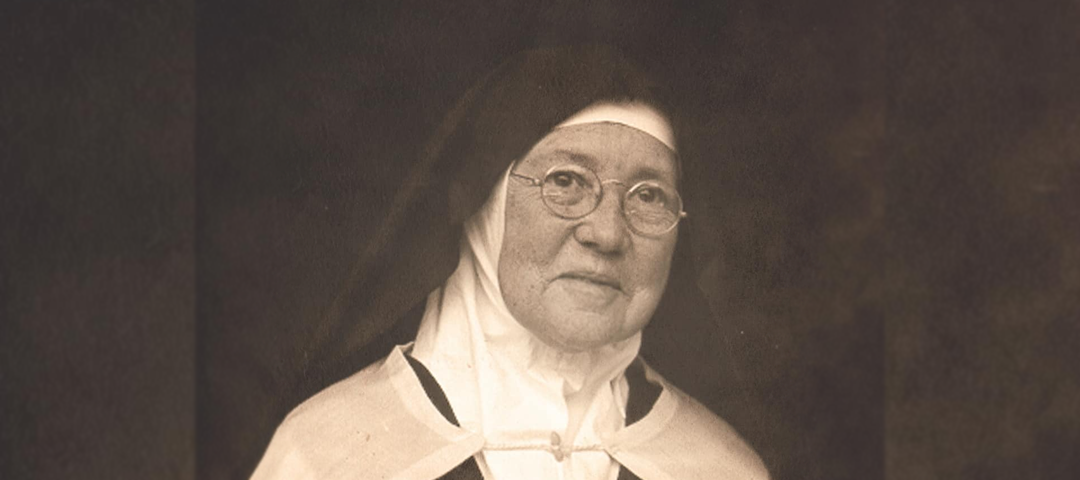
Sometimes the brokenness is outside of us. Perhaps it is brokenness in a marriage as in the case of Rita of Cascia, who became a saint; or the brokenness in a government, as in the life of our own Foundress, Mother Luisita, who is now a Venerable of our Church, soon to be a Saint.
I want to share a little bit of her story with you, not because she is our Foundress or because she will soon be our own homegrown saint, but rather because it still bears relevance today, here and now. Nothing can thwart God’s work of love. Her life had so many pieces, it almost seems disjointed.
Mother Luisita was born in 1866 in Mexico, not far from Guadalajara. She felt drawn to the religious life at an early age; however, when she was 15, her father arranged a marriage for her to a prominent physician, Pascual Rojas, a man twice Luisita’s age. That is a broken dream.
As it turned out, it was a true marriage and they grew to love each other deeply. In her love for Pascual, Luisita entered into his profession of caring for the sick; the two of them providing a small hospital for the poor. They were not able to conceive children – another broken dream – so they decided to build an orphanage and adopt the orphans as their own.
God worked through Pascual to help Luisita grow out of herself and prepare her for leadership and God worked through Luisita to help Pascual get in touch with the God who lives within, preparing Pascual, although it was unbeknownst to him, for a saintly death 14 years after they were married.
The rest of her life continued to be filled with broken paths, brick walls and dead-end streets. As a widow, Luisita continued her administration of the hospital and orphanage. Eight years later, when everyone was prepared for new leadership, she could finally follow her heart’s desire and she entered the Carmelite Cloister in Guadalajara, where she was very happy.
However, after just seven months, after consulting with the archbishop she decided to leave. The archbishop had told her how the orphanage and hospital had fallen into neglect and disrepair and were sorely in need of her administrative abilities. She left the cloister. Soon, more and more women began to come to help her and they would stay and pray with her.
As the signs of persecution grew, the archbishop, concerned for their safety, asked Luisita and the women who were serving with her to join an established active religious community. These were neither her plans nor her desires, but she obeyed, allowing herself to be guided by Divine Providence. Mother Luisita was in this community for three years when the Mexican government engaged in a virulent and violent religious persecution against the Catholic Church. The new constitution of Mexico was promulgated in 1917 whereby the church was laicized, religious vows were forbidden, and priests lost their citizenship.
The archbishop again told Mother Luisita that her hospital and orphanage needed her. I do not know what pain she suffered interiorly. I do know that Mother never lost touch with the loving God who lives within. She knew who she was – she was a beloved and a lover of Jesus Christ, therefore, she was anchored interiorly. She could stay steady on her course moving forward because she knew precisely Who was at the helm directing her course.
After making a prayerful retreat to discern what she should do, she returned to the hospital and orphanage. Women gathered around her because she drew them to God. This is what happens. When we allow God’s love to fill us, we can’t help but radiate that love out to others and like a magnet, it draws others to that love, as well. It just happens.
In time, the archbishop suggested that Luisita become the foundress of a new, active Carmelite religious congregation and the Carmelite Sisters of the Sacred Heart were established on February 2, 1921 and she became now Mother Luisita. She had been a widow for 25 years – a long time to walk along a broken path.
By 1924, just three years after the establishment of our community, all seminaries were closed in Guadalajara. Eighteen months later, the Penal Code of Calles was enacted, which provided that those who preach doctrinal sermons or administer the sacraments would be imprisoned; all churches became nationalized property; private primary schools may be established only if subject to government regulation; convents had to be immediately dissolved and if their members secretly came together, those members would be imprisoned for two years, six years for the superiors. Those were indeed very dark days.
The Sisters were split up, hiding in barns and secretly living with different families. Some of our Sisters were imprisoned for being Catholic and Mother feared for all their lives. In June 1927, Mother and her two companion Sisters left the terrible persecution of their homeland in disguise, embarking on a perilous journey to the United States and religious freedom. It was on June 24, 1927, the Feast of the Sacred Heart, that Mother Luisita and the two other Sisters arrived in Los Angeles[i], just a little over a mile from where we sit today, and were warmly welcomed by Archbishop Cantwell.
Even during the darkest of times, Mother steadfastly continued to encourage the Sisters and the laity, “Remember, for greater things you were born.” When she herself was near death and external circumstances were still very precarious, her trust in God’s loving providence never wavered: “Let us bless our good God for everything. He loves us very much and He disposes everything for our own good.”
Her cause for sainthood is far along. We have hundreds and hundreds of letters from people testifying that Mother has interceded on their behalf and that she has been with them throughout their struggles, and has given them hope, consequently changing their lives profoundly.
How could this be? How could a woman whose life was continually marked by broken dreams and dead-end streets still be bearing fruit today? It’s really quite simple. She allowed God to love her. She allowed God to kneel on the kitchen floor of her life and take care of the broken shards. Her humble and consistent efforts of 100 years ago are still bearing beautiful scintillations of God’s nearness. That is who God is and that is what God does.
[i]Central Station was located at Central Avenue (approximately 450 S. Central) at the intersection of 5th street until our current Union Station was built in 1939.